
Precious Metal Hydrometallurgical Refining System
— Turnkey Precious Metal Hydrometallurgical Refining Plant
Precious metal hydrometallurgical refining system is a technique that uses chemical solvents such as acids and alkalis to selectively dissolve precious metals (gold, silver, platinum, palladium, etc.) in raw materials under ambient or heated conditions, and then separates and purifies them through reduction, displacement, adsorption, or electrowinning. This process has core advantages such as high product purity (up to 99.99%), strong adaptability to raw materials, low energy consumption, and relatively small equipment investment, and is widely used in the recycling of electronic waste, jewelry waste, and industrial catalysts.
The recovery rate of precious metals such as gold, silver, palladium, platinum, copper, rhodium, iridium, and ruthenium is 99%, with a purity of 99.99%.
Product Overview
Our precious metal hydrometallurgical refining system is a complete, turn-key solution for recovering and refining gold (Au), silver (Ag), platinum (Pt), palladium (Pd) and rhodium (Rh) from a wide range of feed materials — e-waste, spent automotive catalysts, anode slime, jewelery scrap and mining concentrates.
Unlike traditional pyrometallurgical smelting, our hydrometallurgical process dissolves target metals into solution and separates them selectively through chemical refining. The result: higher recovery rates (Au ≥ 99%), purities up to 99.99%, lower energy consumption and minimal emissions — a cleaner, more profitable way to refine precious metals from both primary ores and urban mining resources.
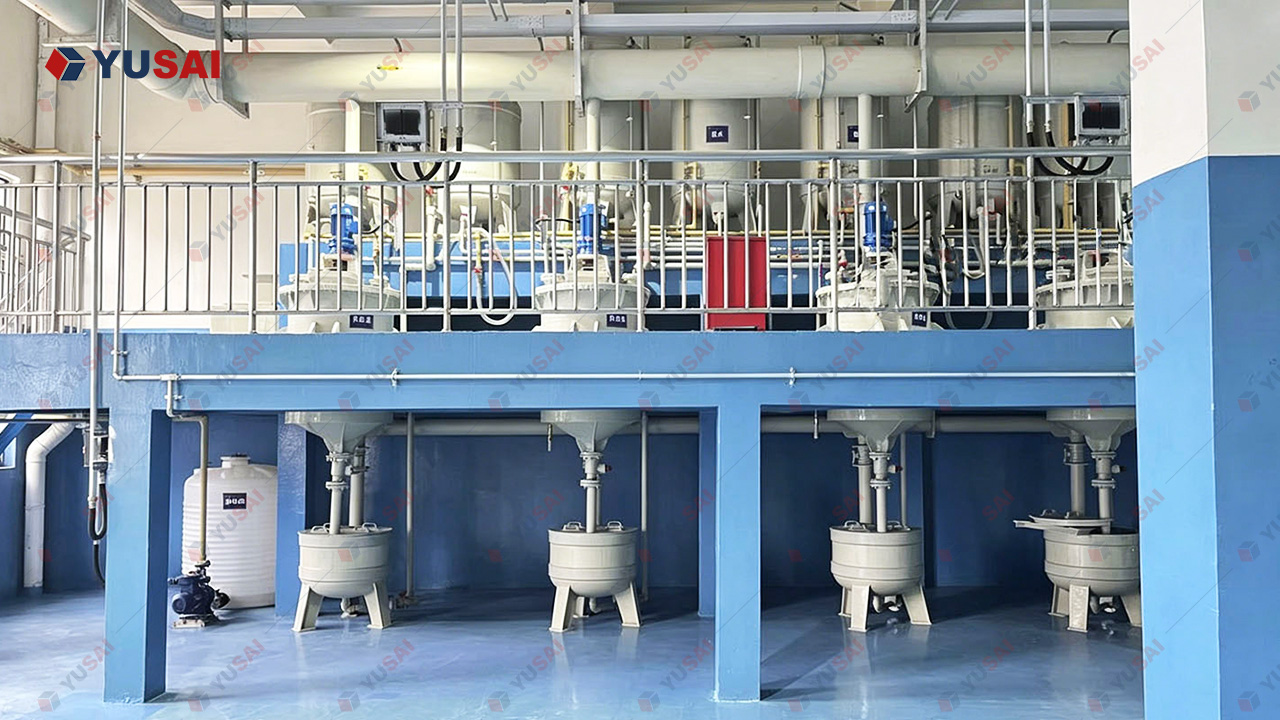
The system is engineered, manufactured and commissioned as a complete package: leaching reactors, solid-liquid separation, solvent extraction and ion-exchange separation, electrowinning, melting & casting, plus full fume scrubbing and wastewater treatment. Customized line capacities from laboratory scale (1–5 kg/batch) to industrial scale (100+ kg/day) are available.
Key Features & Selling Points
- High recovery, high purity — total gold recovery ≥ 99%, final purity up to 99.99% (four-nines), PGM purity 99.95%–99.99%
- Multi-feedstock capability — handles e-waste, spent catalytic converters, anode slime, jewelery scrap and concentrates in one system
- Selective separation technology — controlled-potential chlorination, solvent extraction and ion-exchange to separate Au, Pt, Pd, Rh one by one, even for the most difficult rhodium recovery
- Low operating cost — low-temperature aqueous processing, reduced energy use versus smelting, reagent consumption optimized
- Green & compliant — closed-loop fume scrubbing (NOx/Cl₂), wastewater treatment to discharge standards, meets international environmental requirements
- Flexible capacity — modular design scales from pilot (1–5 kg/batch) to industrial production (100+ kg/day)
- Corrosion-engineered equipment — glass-lined reactors for aqua regia duty, titanium reactors for nitric acid circuits, Hastelloy-lined autoclaves for pressure leaching
- PLC/DCS automation — automatic temperature, pH, ORP and dosing control for consistent, repeatable results
- Full service package — process design, equipment supply, installation supervision, operator training and after-sales support
- Customized configurations — gold-only lines, silver lines, PGM lines, or fully integrated multi-metal refining plants
Applicable Raw Materials
Our system is designed around your feedstock. Typical input materials include:
E-waste & electronics
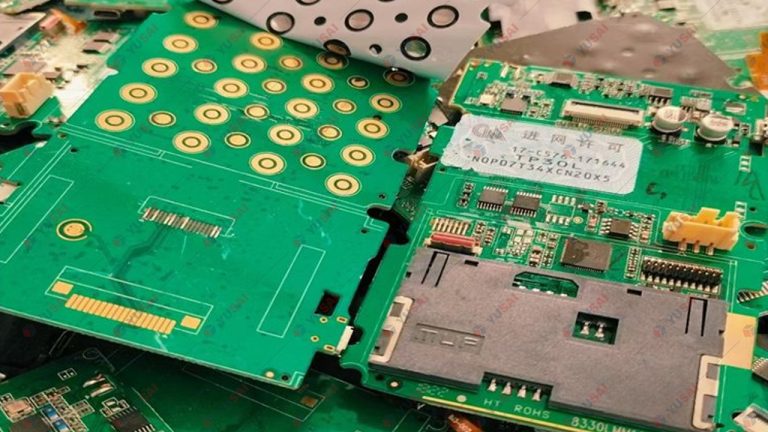
- Waste PCB boards and motherboards (200–300 g gold per ton, plus silver, palladium and copper)
- Mobile phone boards, CPUs, memory modules and SIM cards
- Gold-plated connectors, fingers and plating scrap
- Electronic components (capacitors, relays, contacts)
Spent catalysts
- Spent automotive catalytic converters (Pt, Pd, Rh)
- Petrochemical reforming catalysts (Pt-Sn, Pt-Re)
- Chemical and hydrogenation catalysts (Pd, Pt, Rh)
Smelting intermediates
- Copper/gold electrolytic anode slime (20–40% gold)
- Smelting slag, flue dust and precious metal melting residues
Jewelery & industrial scrap
- Used jewelery and workshop sweeps
- Polishing dust and gold-bearing ash
- Gold/silver plating solutions and electroplating anode slime
- Dental alloys
If you are unsure whether your material is suitable, send us a sample — our lab will run fire assay / ICP analysis and recommend the optimal process flow.
Precious Metal Hydrometallurgical Refining Process Flow
Every refining line follows our proven six-step hydrometallurgical route. Each step has clear process objectives, key parameters and quality control points, with the entire line automated by PLC/DCS for consistent, repeatable results.
Step 1: Pre-treatment — Enrichment & De-contamination
Dismantling to remove casings, batteries and plastics → two-stage crushing and screening for size control → rotary kiln roasting (350–550°C) to remove organics and plastics → magnetic separation for iron and eddy-current separation for aluminum/copper matrices.
The goal is to multiply the precious metal grade several times while preventing organics from consuming reagents later in leaching. Key control points: output particle size of 80–200 mesh (the standard range maximizing leach contact area); roasting too hot causes metal sintering and encapsulation, too cool leaves organics incompletely removed.
Step 2: Leaching — Dissolving Precious Metals into Solution
- Aqua regia system (gold, platinum, palladium): HCl:HNO₃ ≈ 3:1, reacted at 60–95°C; gold enters solution as HAuCl₄ with leaching rate ≥ 98%;
- HCl + oxidant system (controlled-potential chlorination): Cl₂ gas or H₂O₂/NaClO₃ added, with real-time ORP monitoring for selective dissolution — base metals remain in the residue;
- Nitric acid system (silver & base metals): nitric acid dissolves silver and copper/nickel matrices while precious metals stay in the residue for enrichment;
- Pressure oxidation leaching (optional): HCl + O₂ in an autoclave at 100–150°C under high pressure, for refractory materials and PGM concentrates with higher recovery.
Key control points: leach temperature, acidity, ORP, reaction time and liquid-to-solid ratio are all automated; NOx/Cl₂ fumes are scrubbed and the plant operates under negative-pressure ventilation.
Step 3: Solid-Liquid Separation — The Value Gate
Leach slurry is filtered through plate & frame / membrane filter presses; the filtrate proceeds to separation, while the filter cake undergoes 2–3 stages of counter-current washing to recover entrained precious metal solution.
Key control points: cake moisture, wash water volume and wash liquor concentration are assayed batch by batch to hold precious metal loss below 1%; polishing filters protect the downstream extraction and resin systems.
Step 4: Purification & Separation — The Core Stage
- De-contamination: base metals (Cu, Fe, Ni) are removed first and metal oxidation states adjusted to prepare the solution for extraction;
- Solvent extraction (SX): metals are separated one by one in mixer-settlers by multi-stage counter-current extraction in the order Gold (Au) → Platinum (Pt) → Palladium (Pd) → Rhodium (Rh) — DBC/TBP for gold, amine extractants (e.g. Alamine 336) for platinum, oxime/amine extractants for palladium;
- Ion exchange (IX): anion-exchange resins adsorb PtCl₆²⁻ and PdCl₄²⁻ complexes, ideal for polishing low-concentration solutions;
- Precipitation / cementation: ammonium chloride precipitation for platinum, dimethylglyoxime precipitation for palladium, silver chloride precipitation followed by zinc/iron cementation for silver powder.
Rhodium separation is the most difficult; we combine multi-stage extraction with ion exchange to reach 84–94% rhodium recovery from spent catalysts — at the forefront of the industry.
Step 5: Reduction / Electrowinning — Recovering Pure Metal
Gold solutions are reduced with SO₂ (the purest option), oxalic acid or sodium sulfite; gold powder is washed to neutral and dried. Electrolytic refining (gold/silver) uses crude metal anodes to produce 99.99% pure gold and silver. Low-concentration solutions are recovered directly by electrowinning.
Key control points: reduction endpoint verified with stannous chloride test to avoid gold residue in the mother liquor; electrolyte is regularly assayed for acidity, metal concentration and impurities.
Step 6: Melting & Casting — Finished Product
Vacuum drying of gold/silver powder → medium-frequency induction melting (above 1,064°C) → casting via graphite crucible → ingot mold forming → ingot-by-ingot QC by spectrometer (ICP-OES), with a purity report issued with every shipment. Standard 1 kg / 5 kg / 12.5 kg gold ingots and custom shapes are available.
Metal-Specific Process Lines (Customizable)
- Gold line: aqua regia / controlled-potential chlorination / electrolytic refining / solvent extraction — choose one or combine, according to feed purity and capacity.
- Silver line: nitric acid leaching + Möbius electrolysis, purity 99.99%.
- PGM line: dissolution → solvent extraction separation → reduction → calcination, producing sponge platinum, sponge palladium and high-purity metal salts.
- E-waste line: base-metal matrix leaching first to remove impurities and enrich precious metals, then into the gold/PGM refining section.
- Spent catalytic converter line: carrier crushing → sulfuric acid leaching of the carrier → aqua regia / HCl+Cl₂ leaching of precious metals → solvent extraction separation of Pt, Pd, Rh.
Equipment Scope Of Supply
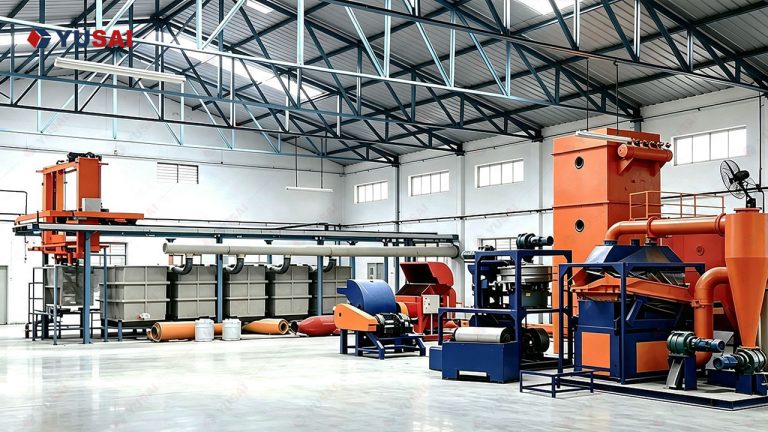
Pre-treatment — jaw/hammer crushers, ball mill, rotary kiln, vibrating screen, magnetic & eddy-current separators
Leaching & reaction — glass-lined reactors (aqua regia), titanium reactors (nitric acid), PP-lined leach tanks, pressure autoclaves (Hastelloy-lined), agitation & heating systems, chlorine gas distribution
Solid-liquid separation — plate & frame filter presses, membrane filter presses, rotary vacuum filters, centrifuges, clarifiers & polishing filters
Separation & purification — mixer-settler solvent extraction units, pulse extraction columns, ion-exchange columns, precipitation reactors, cementation tanks
Reduction & electrolysis — reduction reactors, gold/silver electrolytic cells, electrowinning cells, rectifiers
Melting & QC — medium-frequency induction furnaces, graphite crucibles, ingot molds, mold pre-heaters, ICP-OES / spark spectrometers
Environmental systems — fume scrubbers (caustic/urea absorption for NOx & Cl₂), wastewater treatment (neutralization, precipitation, ion-exchange), ventilation, PLC/DCS automation
Recovery Performance & ROI
| Metal | Recovery Rate | Purity |
| Gold (Au) | ≥ 99% | 99.99% |
| Silver (Ag) | ≥ 97% | 99.99% |
| Platinum (Pt) | ≥ 94% | 99.99% |
| Palladium (Pd) | ≥ 96% | 99.99% |
| Rhodium (Rh) | ≥ 94% | 99.99% |
With precious metals at record prices — gold above USD 4,350/oz and rhodium above USD 8,200/oz (Aug 2026) — a single ton of PCB scrap carries 200–300 g of gold worth roughly USD 28,000–42,000 in metal value alone. Payback analysis and ROI projection are available on request with your actual feedstock data.
Quality, Compliance & Safety
- Fire assay and ICP-OES/ICP-MS double-verification for product purity, quality reports issued with every batch
- Fume scrubbing and wastewater treatment engineered to international discharge standards
- Hazardous waste handling per local regulations (hazardous waste operating license required for e-waste/catalyst processing)
- Safety-first design: gas alarm systems, explosion-proof handling of organic solvents, forced ventilation
- Metal balance management: full-process sampling and accounting to keep total metal loss under 1%
Services & Support
- Sample testing — free laboratory analysis (fire assay / ICP) of your material
- Process design — flowsheet and mass balance tailored to your feedstock and capacity
- Equipment supply — complete lines or individual units
- Installation & commissioning — supervision on site, plus operator training
- After-sales — spare parts, technical support and process optimization
FAQ
Q1: What purity can your refining system achieve?
Gold and silver up to 99.99%; platinum, palladium and rhodium up to 99.95–99.99%.
Q2: What materials can you process?
E-waste (PCB, phone boards, SIM cards), spent catalytic converters, anode slime, jewelery scrap, dental alloys and mining concentrates. Send a sample for free testing.
Q3: Is rhodium recovery included?
Yes. Our multi-stage solvent extraction + ion-exchange combination achieves 84–94% rhodium recovery from spent catalysts.
Q4: What is the minimum order / capacity?
Lines start from pilot scale (1–5 kg/batch) up to industrial scale (100+ kg/day). Tell us your feedstock volume and we will size the system.
Q5: Do you provide installation and training?
Yes — installation supervision, commissioning and full operator training are included with every line.
Q6: Can you handle hazardous waste regulations?
We design environmental systems (fume scrubbing, wastewater treatment) to meet local discharge standards, and advise on the hazardous waste permits required in your region.

Request a free quote
Please leave your contact information, and our technicians will reply to you within 2 hours.
- +86 18339216321
- info@yusaipreciousmetals.com
- Zhengzhou.Henan.China
If you are interested in our equipment, please feel free to contact us!
- +86 18339216321
- info@yusaipreciousmetals.com
- zhengzhou.henan.china